

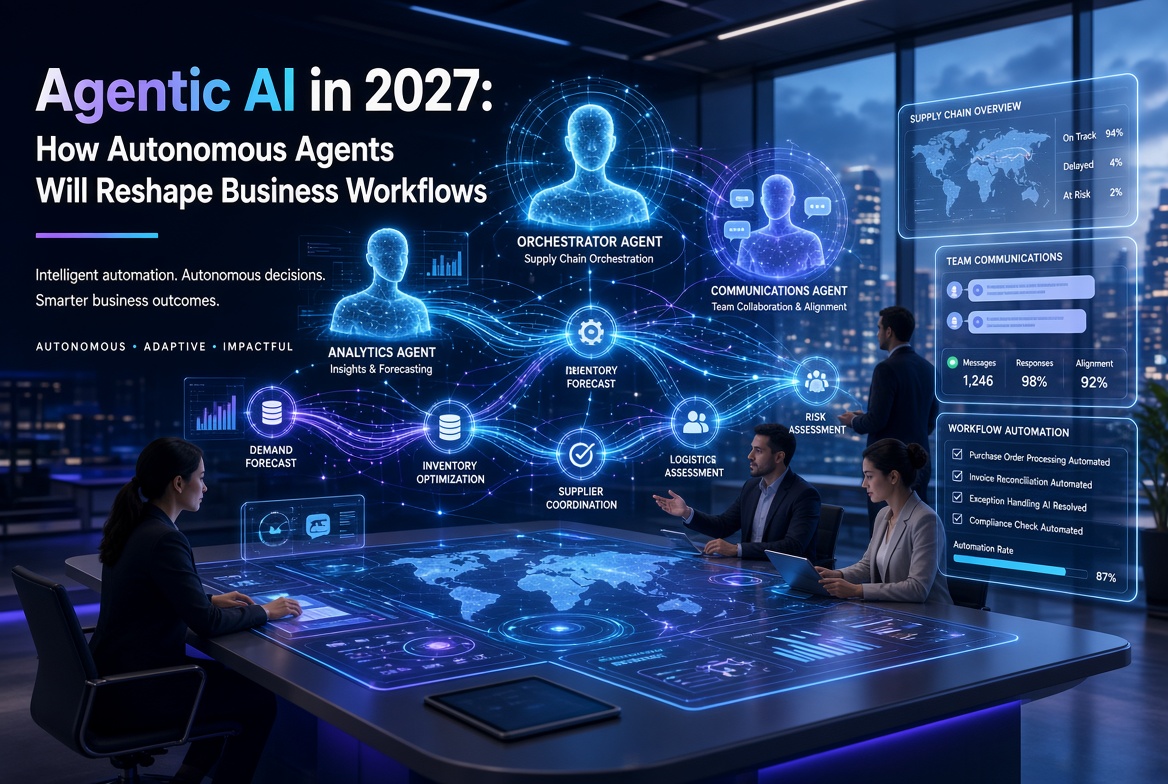
Agentic AI is moving from promising pilots to the backbone of how work actually gets done—and 2027 will separate the organizations that redesign around it from those still bolting it onto yesterday’s processes.
As of late 2026, AI agents have progressed well beyond chatbots and copilots. These systems plan multi-step tasks, call tools and systems, adapt when conditions change, and hand work to other agents or people. They start work, keep processes moving between human decisions, and increasingly operate with bounded autonomy. Gartner expected task-specific agents to appear in 40% of enterprise applications by the end of 2026 (up from under 5% in 2025). McKinsey data showed roughly 40% of large organizations scaling agents, though measurable enterprise-level EBIT impact remains concentrated among a smaller group of high performers.
The production reality is sobering. Only about one in four agentic initiatives reliably reaches production, many journeys take a year or longer, and Gartner has forecast that more than 40% of agentic AI projects will be canceled by the end of 2027—primarily due to escalating costs, unclear business value, or inadequate risk controls.
What “agentic” really changes in workflows
Traditional automation follows rigid rules or scripts. Generative AI answers or drafts. Agentic systems pursue goals: they break work into steps, gather context, act across systems, recover from exceptions within guardrails, and escalate only when needed.
In practice this means:
- Routine multi-step work shifts to agents. Invoice matching and exception flagging, lead research and CRM updates, ticket triage with account context and draft replies, access resets and log collection, supplier risk analysis, and first-pass code changes or documentation updates are already common starting points.
- Processes get redesigned, not just automated. High performers are far more likely to rebuild workflows around agents rather than layer agents on top of broken or human-centric processes. Deloitte research shows most leaders expect nearly half of processes to be redesigned around agents within a few years, with agents running continuously and coordinating across functions, while humans move primarily into oversight.
- Multi-agent teams emerge. One agent hands off to another with different skills; a third of observed agent work already involves handoffs. By 2027, Gartner expects one-third of agentic implementations to combine agents with complementary skills for complex tasks. Cross-company agent interactions (vendor and customer agents settling orders or closing reports) are beginning to appear.
- Humans shift from doing the work to deciding and supervising. A productive week increasingly becomes a short list of decisions and exceptions, with the underlying execution already advanced by agents. Long-horizon agents that pursue goals over hours or days are moving from research into early production use.
What 2027 looks like for business workflows
Several clear signals point to 2027 as a transition year from experimentation to production discipline:
- Agents will start more of the day-to-day work while people retain most consequential decisions.
- Context platforms and semantic data layers will become table stakes. Organizations that prioritize AI-ready data and business semantics can improve agent accuracy significantly and cut costs sharply; without them, token waste, hallucinations, and over-privileged agents remain chronic problems.
- Governance, identity, and cost controls harden. Agents need their own identities, scoped permissions, audit trails, and rollback mechanisms. AI FinOps (linking spend to outcomes in near real time) moves from nice-to-have to necessary as inference costs scale. Legacy credential models and unmanaged machine privileges create material security risk.
- Pricing and measurement evolve. Seat-based software models clash with outcome-driven agent work. Successful programs track cost per completed outcome, exception rates, cycle time, quality, and downstream business impact rather than activity volume alone.
- Competitive advantage tilts toward process redesign and operating-model change. The organizations that treat agents as a new form of digital labor—complete with supervision models, clear escalation boundaries, and continuous evaluation—will pull ahead. Those that treat agents as another software feature will struggle with the cancellation wave.
IDC anticipates that by 2029 a majority of Global 2000 enterprises will run most business processes in an AI-first manner, with continuous verification of agent decisions becoming far more common. The foundations for that shift are being laid now.
Practical implications and how to prepare
Success requires treating agentic AI as an operating-model change, not a technology project:
- Start with high-volume, rules-rich, multi-system processes that have clear success criteria and measurable baselines (cost, cycle time, error rate, exceptions).
- Redesign the end-to-end workflow so agents own the executable path and humans own the decision and exception gates.
- Invest early in data readiness, integration, and a context layer that gives agents reliable business semantics.
- Build governance into the design: permissions as code, cost ceilings per outcome, evaluation on live traffic, and clear accountability.
- Reskill for supervision and orchestration. The scarce capability shifts from pure execution to defining goals, reviewing agent output, handling edge cases, and continuously improving the system.
- Measure ruthlessly. Programs that cannot tie activity to a profit-and-loss line or operational KPI lose funding.
Examples already delivering value include self-service support agents that cut live transfers and raise first-contact resolution, finance agents that surface exceptions with supporting context, and engineering agents that propose and test changes under human review.
The bottom line for 2027
Agentic AI will not eliminate knowledge work. It will reallocate it. Agents will handle more of the continuous, multi-step, cross-system execution. People will focus on judgment, exceptions, strategy, relationship, and innovation. The organizations that win will be those that redesign processes and operating models around this division of labor, install real guardrails and measurement, and treat agents as managed digital workforce rather than magical software.
The technology is ready enough. The differentiator in 2027 will be operational maturity: clear ownership, process readiness, trustworthy data and context, disciplined cost control, and the willingness to change how work itself is structured. Those that treat the next 12–18 months as a period of disciplined scaling rather than more pilots will enter 2028 with a durable advantage.


